DAVINCI / INSIGHTS
A surveillance camera can produce an impressive specification sheet and still fail to capture the information a site actually needs. Useful image quality starts with the scene, the subject and the purpose of recording.
Start with the viewing objective
First define whether the camera is intended for broad awareness, observing activity, recognizing familiar people or capturing identifying detail under realistic conditions. These outcomes require different fields of view, mounting positions and pixel density at the relevant distance.
A camera aimed across a large courtyard may offer excellent overview coverage but limited detail of faces far away. Conversely, a narrow view that captures detail at a gate might miss surrounding activity. Both perspectives can be valuable within a planned system.
Resolution is only one input
Higher sensor resolution can support more detail if the lens, sensor, illumination, compression and recording configuration preserve it. It does not automatically compensate for a poorly chosen viewing angle or a distant subject.
The recorded stream also matters: excessive compression, low bitrate and unsuitable frame rates can erase detail that appears available in a live preview. Evaluate retained footage, not only the promotional still image.
Lens focal length shapes the scene
A wider lens generally covers more of the area but makes a distant subject occupy fewer pixels. A narrower view concentrates available pixels on a smaller area. Position, lens selection and mounting height should be decided together, with realistic test images from the intended locations.
If a varifocal lens is selected, confirm focus and field of view after final installation. Avoid mounting positions that create persistent backlighting, glare or severe occlusion.
Low light is a system challenge
Night performance depends on sensor size, optics, exposure settings, available illumination and movement in the scene. A bright stationary night image may conceal motion blur when someone walks through the frame. Infrared illumination can help certain cameras, but reflections, surfaces and long-distance falloff affect results.
Where privacy and local rules permit, deliberate scene lighting may produce more usable evidence than relying entirely on the camera. Test a person moving through the actual scene at night, not merely a static target.
Dynamic range and challenging lighting
Entrances often combine bright outdoor light with dark interior areas. Wide dynamic range functions can help when tuned appropriately, but their performance varies by device and conditions. Review the camera’s actual output across morning, evening and artificial-light scenarios.
Choose equipment through on-site validation, and specify the desired result in understandable operational terms.
Measure detail at the target, not just at the sensor
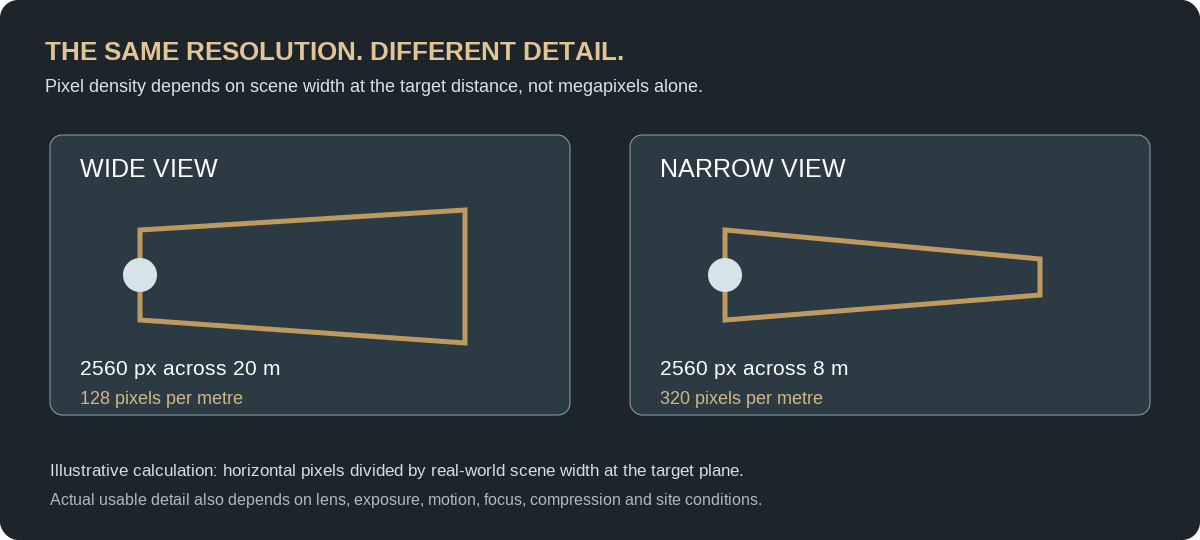
A practical way to evaluate camera placement is to calculate the approximate horizontal pixel density at the subject plane: recorded horizontal pixels divided by scene width in metres. For a 2560-pixel image, a scene spanning 20 metres yields about 128 pixels per metre; framing a narrower 8-metre view gives 320 pixels per metre. This is an illustrative geometry calculation, not a guarantee of identification, because focus, motion, compression, lighting and lens performance can reduce effective detail.
Test motion at night, not just a static image
Exposure that makes a dark scene look bright can also cause moving subjects to blur. Compare samples of people walking through the actual scene at the intended frame rate, using both ambient and infrared illumination where available. IR reflections from nearby walls, glass or rain can reduce useful detail; placing the camera differently may improve results more than increasing resolution.
Consider backlight, recording and retrieval
Wide dynamic range can help at bright entrances, but must be assessed with real faces and moving subjects, not only manufacturer demonstration images. Verify recorded playback after encoding and retention, not just the live monitor. Confirm that stored clips preserve useful exposure, detail, color or IR contrast, and timestamps in the required conditions.
Commission cameras against a practical brief
- Define what the operator needs to see at each distance.
- Verify the chosen lens field of view with a person or target in the actual location.
- Compare daytime, dusk, night, and backlit recordings with movement.
- Check compressed recorded streams and exported clips rather than screenshots alone.
- Reassess glare, occlusion, privacy, mounting height and scene lighting before signing off.
DAVINCI perspective: Thoughtful planning starts with site conditions and real users. Product suitability, installation details and local requirements must always be checked for the actual project.